Most of my work takes the form of drawings and paintings on paper, alongside occasional spatial work and photography.
I stop when a work begins to close itself too clearly. Often a piece begins with something small: a line from a poem, a memory of light near the sea, a found object, or a combination of colours that has stayed with me. When I start working the process usually moves quickly, following the marks or materials to see where they lead.
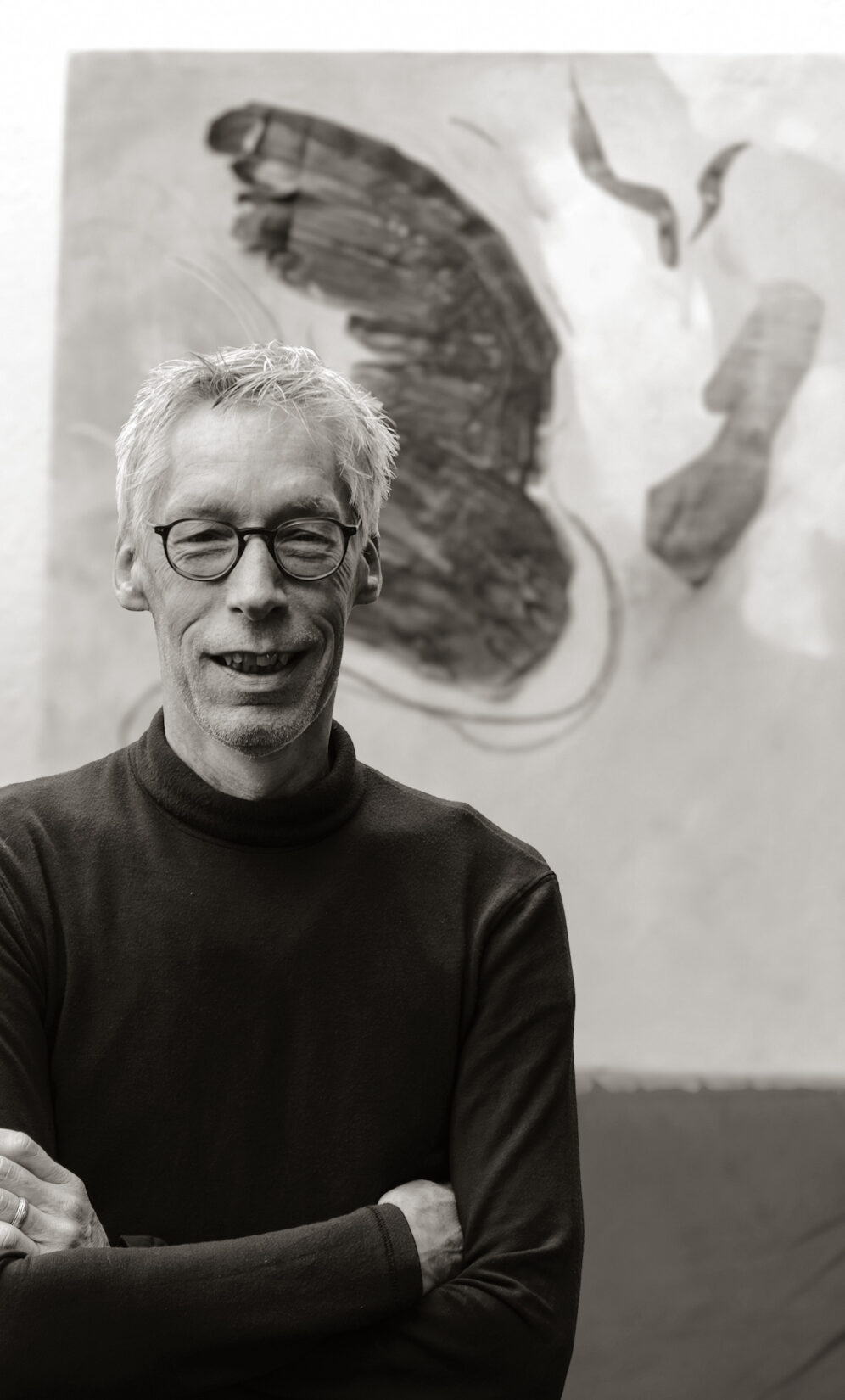
My aim is not to illustrate an idea or arrive at a perfect composition. What interests me is the moment when a work begins to feel alive — when lines, colours, materials or forms start interacting and creating their own tension.
At that point the task becomes mostly one of attention. When the work starts to settle too neatly, I stop. Leaving something open feels more truthful than forcing it into a finished object.
In some work this process unfolds quickly, driven by gesture and immediacy. In other cases it develops more slowly, allowing time, layering and accumulation to play a larger role. Both approaches are ways of testing how far a work can hold itself without being resolved.
Drawing, making and photographing are ways of slowing down and entering a different kind of attention. The works that result are traces of those moments. The practice moves across surfaces and contexts, but remains rooted in a continuous process of looking, responding and adjusting.
process
Work usually begins by setting a few simple conditions: the size of the paper, the tools, the placement of an object, or a first mark. From there the work develops through a series of responses.
Lines, colours, materials or elements in space react to each other, and the process follows these interactions rather than a predetermined image.
While working I watch for the moment when the work begins to hold itself. When further intervention would close it too much, I stop. Many works remain slightly unresolved on purpose, while others are allowed to develop over a longer period of time.
technique
Much of the work is done on paper, using pencil, soft pastel, ink and other dry materials, sometimes combined with thin layers of paint.
In parallel, some works take a more spatial form, using found materials, clay or simple constructions. Photographic work focuses on situations where form and colour begin to approach abstraction.
Across all of these, materials are chosen for their directness and responsiveness. Surface, texture, light and context play an important role in how elements develop and interact.
context
Some works on this site are presented within constructed spatial images.
In these cases, both the work and the surrounding space are treated as part of the same process. The images are not meant as documentation, but as situations in which a work can extend beyond its physical edges.
For inquiries or comments, feel free to email me at fransaussems@gmail.com.